
How an AI adoption action plan improves workflow change

Quick answer: an AI adoption action plan improves workflow change by turning AI from optional sidecar behaviour into a defined part of how work gets done, then measuring what actually changes.
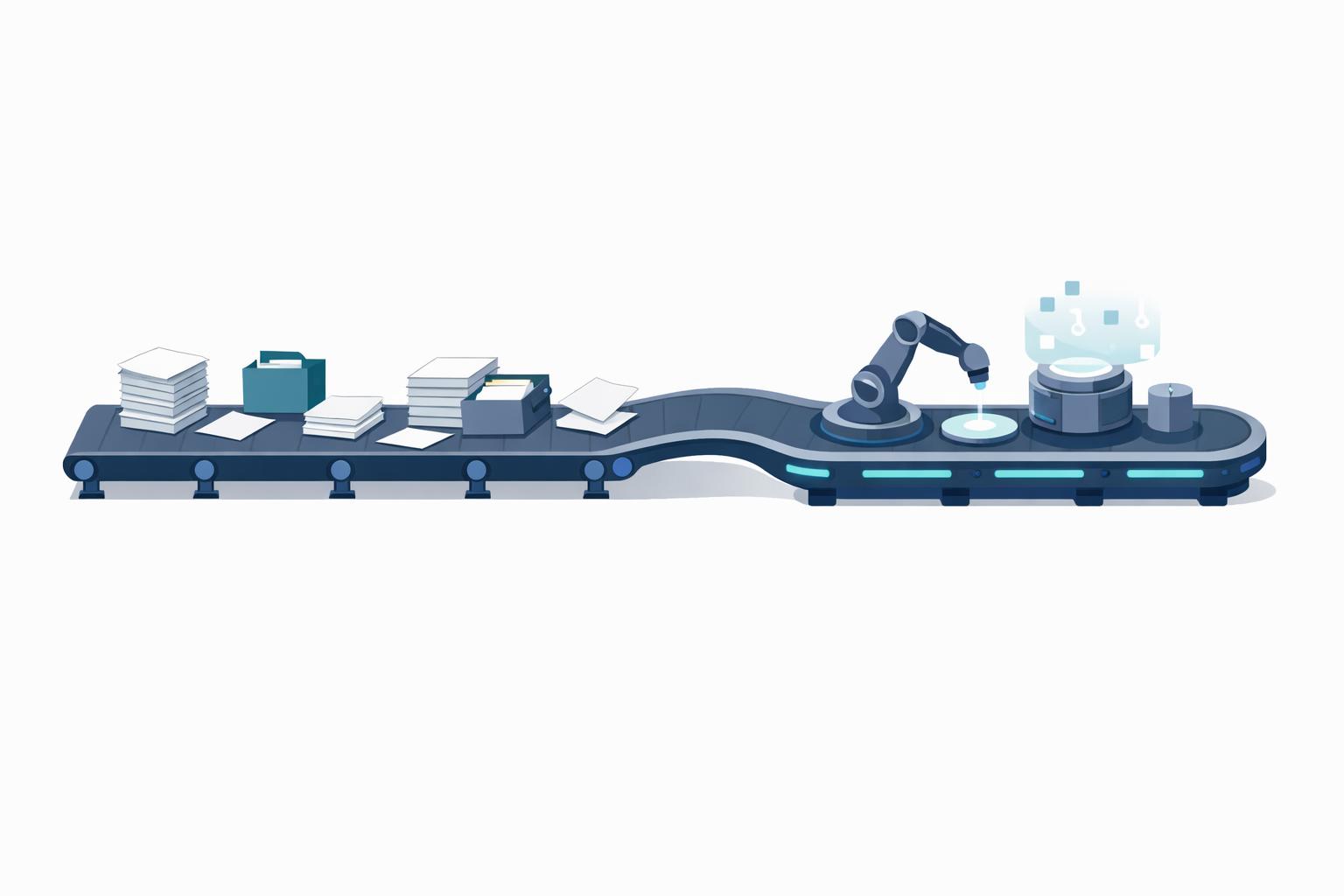
Most teams do not have an AI access problem. They have a workflow problem. BCG reported in 2024 that 74% of companies still had not shown tangible value from AI despite heavy investment, and its 2025 follow-up found more than 85% of employees were still in early adoption stages where usage is real but impact is thin. An AI adoption action plan improves workflow change by turning AI from optional sidecar behaviour into a defined part of how work gets done - task by task, team by team. The point is not more licences or another AI week; it is redesigning recurring workflows, assigning owners, setting evidence of good use, and measuring whether behaviour actually changed.
An AI adoption action plan is a structured plan for moving a team from tool availability to workflow-level adoption: which jobs should change, where AI fits in each step, what “good” looks like, who needs enablement, and how progress will be measured. That matters whether you run a product team using GitHub Copilot and Cursor, a marketing team drafting campaign variants in ChatGPT Enterprise, or an operations team using Microsoft Copilot inside Excel, Outlook, and Teams. GitHub has said Copilot is used by millions of developers, but the failure mode is still the same inside most companies: people prompt occasionally, save a few minutes, then fall back to the old process because no core workflow was rewritten. The point is to make the new flow explicit, like how Atlassian teams document work in Jira or how engineering teams use a Definition of Done in Scrum: if the process does not change, adoption stays shallow.
This article shows how to build that plan in practice: identify high-frequency workflows, spot where adoption is shallow, separate champions from surface users, and map findings to specific interventions. That matches the broader market data: according to McKinsey’s State of AI 2025, only 23% of respondents said their companies were scaling agentic AI somewhere in the business. The gap is not awareness. It is operationalisation.
TL;DR
- Audit your highest-frequency workflows and pick one repetitive bottleneck where AI can replace steps, not just speed up drafting.
- Define the new task order, decision owner, and review gate so AI output changes the process instead of adding another handoff.
- Interview users, then separate champions from surface users and map each group to a different intervention.
- Set evidence standards for "good use" and require artifacts, not self-reports, before you call a workflow adopted.
- Re-measure the same workflow after rollout and keep only the changes that move output quality, speed, or throughput.
Why do most AI rollouts stall at shallow adoption?
Most rollouts stall because AI gets inserted as a drafting shortcut, not as a redesign of the task. People use ChatGPT, Copilot, or Gemini to produce a first pass faster, but the review queue, approval path, and ownership model stay untouched. So the old process still governs throughput. The bottleneck moves downstream: managers review more drafts, handoffs multiply, and staff fall back to the pre-AI route when deadlines tighten. That is why shallow adoption is usually a workflow design problem, not a prompt training problem, a pattern also described by BCG’s 2025 adoption analysis and Harvard Business Review’s 2026 review of industry data.
You can see the gap in the market data. In 2024, only 26% of companies had built the capabilities needed to move beyond proofs of concept and generate tangible value, according to BCG’s global survey of 1,000 executives. Usage is spreading; workflow change is not.
A simple test helps. Access means people may use AI. Workflow change means the team has changed what happens, by whom, and in what order. At a Hamburg-based insurance broker we worked with, a two-day AI week and Copilot licences produced lots of email drafting but little operational change; 20-minute voice interviews showed a few claims specialists had already rebuilt case-summary work, while most colleagues had no clear guardrails or safe task boundaries. The fix was not another generic session. It was a team AI enablement plan: pick one frequent, repetitive, reviewable bottleneck, define who prompts, who checks, what evidence counts as acceptable output, and where human review remains mandatory.
How do you build an AI adoption action plan for workflow change?
An AI adoption action plan starts with one real workflow, not a training calendar. Map the task end to end, then assign specific changes to prompts, roles, and review points so behaviour changes in the work itself.
-
Pick one workflow with visible pain and define the output that must improve. Good candidates are support triage, candidate screening, claims summaries, or internal knowledge retrieval. “Use AI more” is not an output. “Reduce time to first triage decision” or “produce a first-pass summary with cited policy references” is.
-
Map the current path end to end. List inputs, prompts already used, systems touched, approvals, and where work waits. Microsoft’s Cloud Adoption Framework recommends documenting workflows and gathering stakeholder input to find where AI should automate, assist, or improve decision quality (Microsoft Learn guidance, Gartner on AI roadmaps).
-
Redesign the default. Specify where AI drafts, where humans decide, what evidence must be attached, and what “good” means. A recruiting team, for example, might require every AI-screened shortlist to include source quotes from the CV and a human fairness check before outreach.
-
Assign three owners: adoption, quality, and operational change. Shared ownership usually means nobody fixes the broken handoff between model output and process.
-
Pilot with a small cohort and measure baseline versus after-state. As of 2026, practitioner guidance increasingly stresses trust and revision rates, not just raw usage; tracking how often AI output is manually reworked is often more revealing than licence logins (Martin Jordanovski on measuring AI impact, Microsoft Cloud Blog’s AI Strategy Roadmap).
-
Turn what worked into a team enablement plan. In one Hamburg insurance case, generic “AI week” training had gone nowhere; progress started only after claims specialists standardised a review-and-draft flow for first-pass case summaries, then taught that exact process to peers. Train on the workflow, not the tool.
How do you measure whether the plan is changing behaviour?
You measure behaviour change by comparing the work before and after the plan, not by counting seats, prompts, or happy survey answers. If the task still moves through the same handoffs, review loop, and decision path, adoption has not happened even if usage is high.
-
Track task-level deltas, not platform activity. For the workflow you changed, measure baseline cycle time, revision rate, output quality, and completion consistency. In practice, “quality” means rubric-based review: accuracy for legal summaries, policy compliance for HR drafts, acceptance without rewrite for support replies. Engineering teams often add manual revision share as a proxy for trust and usefulness, a pattern also noted in practitioner guidance on AI impact measurement (Martin Jordanovski on Medium); Microsoft’s adoption planning guidance is explicit that plans need actionable execution measures, not just intent (Microsoft Learn Cloud Adoption Framework).
-
Look for evidence inside the workflow itself. Prompt logs are weak evidence; changed artefacts are stronger. Did the claims summary arrive in a new template? Did the analyst attach source checks? Did first-pass work move upstream so reviewers spent time on judgment instead of cleanup?
-
Use a three-level view. Org level shows where adoption is still surface-level. Team level shows which workflows actually changed. Individual level shows who is already operating above the cohort and can act as a champion. This is where interview-led measurement beats checkbox surveys: people regularly report confidence that is not visible in artefacts, while short voice interviews surface where tool fluency exists but output judgment and workflow redesign do not.
When should you use a team AI enablement plan instead of a broad rollout?
Use a team AI enablement plan when adoption is uneven and you need to unlock value in one part of the business fast. It makes sense when one team is already close to useful AI workflows, or when a single bottleneck is slowing output and a focused intervention will move the needle faster than a company-wide programme. Broad rollouts are better for standardisation; team plans are better for getting one pocket of the business unstuck.
The practical rule is simple. If marketing needs brand-safe content review, HR needs policy and candidate-summary guardrails, finance needs traceability, and engineering needs trust controls around code suggestions, one company-wide training programme will spread attention but not remove any team’s actual blocker. Microsoft’s Cloud Adoption Framework explicitly recommends collecting input across functions to identify different pain points and document workflows before prioritising AI work (Microsoft Learn Cloud Adoption Framework).
That is where a team roadmap earns its keep. It lets you sequence interventions by readiness, risk, and business value: champions first, high-friction workflow second, governance hardening third. In one Hamburg-based DACH insurance broker, short voice interviews surfaced a claims subgroup already using Copilot for first-pass case summaries while the rest of the rollout was stuck at email drafting; that made the next move obvious - build around the claims team, not the whole company. Choose a team-level plan if you need speed, evidence, and a proof point; choose a broader rollout only after you have a repeatable workflow pattern, named champions, and governance that can travel across teams (Deloitte Family Business Technology Transformation 2026, Gartner on AI roadmaps).
Bottom line
Most AI rollouts stall because AI gets added as a drafting shortcut, not as a redesign of the task. If you want adoption to stick, pick one high-frequency workflow, rewrite the task order and review gates, and measure whether the new process actually changes output, not just usage. If you need help separating real champions from surface users or turning interview data into an enablement plan, that is where outside support starts to pay off.
FAQ
What should be in an AI adoption action plan?
A useful plan should include a baseline workflow map, a named owner for each step, and a clear definition of what counts as acceptable AI-assisted output. It should also specify the evidence you will collect, such as prompts, artefacts, review notes, or cycle-time data, so you can tell whether the change is real. If you skip the evidence layer, teams usually revert to old habits after the first novelty phase.
How do you know if AI adoption is actually improving workflow performance?
Track the workflow metrics that matter for the job, not generic usage counts. Good measures include turnaround time, rework rate, approval latency, and output quality against a rubric, ideally before and after the same task is changed. A practical rule is to compare at least 2-4 weeks of baseline data with the same period after rollout so you can see whether the new process holds.
What is the difference between AI tool rollout and workflow change?
Tool rollout gives people access; workflow change changes the sequence of work, the decision points, and who is responsible for what. In practice, that means AI is embedded into a specific task flow, such as first draft, fact-check, escalation, or final approval, rather than being left as an optional helper. If the old review chain stays intact, you have adoption theatre, not operating change. - How to judge hackathon: Criteria vs rubric vs winner selection - How to judge hackathon: The complete guide - Jobs-to-be-done: How to apply it to real AI usage data - Best practices for AI champion enablement in 2026
